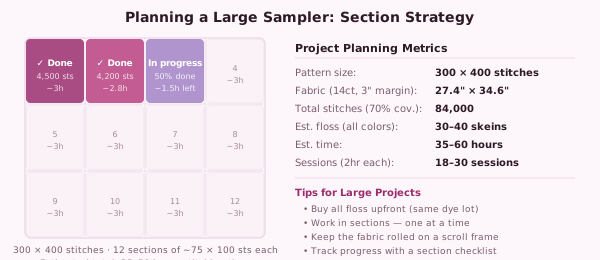
A sampler with 400 rows. A full-coverage landscape that fills a 24-inch frame. A family name piece with 30 different colors and 60,000 stitches. Large cross stitch projects are a different undertaking than a small ornament. They take months, sometimes over a year, and the planning decisions you make at the start have consequences through the entire project.
This guide covers the specific challenges of large-scale cross stitch: fabric selection, floss purchasing, section strategies, and keeping momentum over a long project.
Defining "Large"
For this guide, a large project is anything over 200 × 200 stitches. At 14ct Aida, that's a design area over 14" × 14". These projects take:
- 200 × 200 stitches at 70% coverage: roughly 18,600 stitched crosses, about 12–15 hours
- 300 × 400 stitches at 70% coverage: ~84,000 stitches, 35–60 hours
- 300 × 400 at 100% coverage (full-coverage): ~120,000 stitches, 80–100+ hours
Use the cross stitch calculator to get precise estimates for your specific design. Enter the stitch count and coverage percentage, and the time estimate output tells you what you're getting into before you start.
Fabric Planning for Large Projects
Fabric Amount
A 300 × 400 stitch design on 14-count Aida, with 3-inch margins, needs a fabric piece of 27.4" × 34.6". That's a large piece, well beyond a standard fat quarter. You'll likely be cutting from a half-yard or yard of fabric.
Before you buy, check the cross stitch fabric size calculator for your exact dimensions. Round up to the nearest available size from your supplier. Adding an extra inch of margin beyond the minimum doesn't hurt.
Fabric Type for Large Projects
For large pieces that will be mounted and framed:
- Aida cloth is fine and widely available. For large pieces, Zweigart is the quality standard (Aida # 1007, 18-count Aida # 3793).
- Evenweave and linen (28ct, 32ct) produce a softer, more heirloom look. They're harder to mount perfectly flat, so a professional framer's stretch is recommended for large pieces on fine fabric.
- Both can be pre-washed before stitching to eliminate post-finish shrinkage. For very large pieces, pre-washing matters because a 3% shrink on a 30" piece is nearly 1 inch.
Marking the Fabric
For a large project, you need reliable centering and navigation. Before you stitch a single cross:
1. Find and mark the center with a vertical and horizontal line of tacking stitches in a contrasting thread color.
2. Some stitchers also mark every 10th row/column with tacking stitches, creating a grid over the fabric that mirrors the chart grid. This makes counting far easier because you always know you're within 10 squares of a tacking line.
3. Mark the top edge of the fabric (or use a scrap of ribbon sewn to the corner) so you always know orientation.
Floss Planning
Large projects with 30+ colors and large coverage areas need careful floss planning. The risk isn't running out of one skein. The real risk is running out and finding the replacement comes from a different dye lot.
Strategy: buy all your floss before you start.
1. Use the floss estimator to get a total skein count.
2. Divide by color based on the pattern's color percentage chart (many detailed patterns include this).
3. For the dominant colors (backgrounds, large solid areas), add 20–30% extra.
4. Buy everything in a single purchase if possible, or from the same supplier's stock.
For a 300 × 400, 30-color design, you might need 30–45 skeins total. At $1.50–2.00 each, that's $45 to $90. Buy it all at once. It feels like a large upfront cost, but running out of a background color at 80% completion is far more painful.
Organize before you start: Wind all floss onto numbered bobbins. Use a project card that lists each DMC number, the number of skeins purchased, and a checkmark as each is used. When a bobbin runs low, you can reorder immediately rather than discovering the shortage when you're mid-row.
The Section Strategy
Don't try to work across the entire piece at once. Divide the design into logical sections, by motif, by row, or by a regular grid, and work one section at a time.
Benefits of section work:
- You can see clear progress (finishing a section is satisfying; an unfinished sampler is just a big piece of partially-covered cloth)
- Errors are easier to catch within a small section before they propagate
- You can keep the bulk of the unstitched fabric rolled up safely on a scroll frame
How to divide:
- For a sampler with distinct motifs (flowers, borders, alphabet), work each motif as a section
- For full-coverage landscapes with no natural divisions, use a 10 × 10 stitch grid (matching your tacking thread grid) and work block by block
- Start from the center and work outward, or work top-to-bottom if the design has a clear top (some large designs look like one element is meant to be stitched first)
Frame Choice for Large Projects
A hoop is not the right tool for a 300 × 400 project. A large piece needs a scroll frame or roller frame that holds the full width of the fabric. You scroll to reveal different sections as you work through the design.
For very large pieces, a floor-standing frame frees both hands for the stabbing stitch method (needle comes down from the top, hand under the fabric brings it back up). Two-handed stitching is faster and more consistent than one-handed stitching.
Read our hoop vs. frame guide for a detailed comparison of options and price ranges.
Managing Color Changes
Large designs with complex shading (photorealistic designs, detailed florals, landscapes) involve frequent color changes and many short thread tails. A few techniques help:
Park method: When you finish a section with a color but will need it nearby, "park" the needle with that color in the margin of the fabric, outside the design area. You can return to it without restarting and re-anchoring.
No loose tails: Keep thread tails on the back short (under 1 cm after weaving). Long floating tails on the back of a large piece can show through to the front, especially on fine fabric and pale colors.
Consistent back work: On large projects, the back of the fabric gets complex. A consistently tidy back (horizontal and vertical anchors, no knots, no long floats) makes the piece cleaner and lighter when framed.
Time Management
A 300 × 400 piece at 70% coverage takes roughly 35–60 hours. At 2-hour sessions, that works out to 18–30 sessions. At 3 sessions per week, which works out to 6–10 weeks of regular stitching.
At 1 session per week: 5–7 months. This is common.
Planning reality: large projects get set aside, picked up, set aside again. That's fine. The key is:
1. Keep the project bag accessible so it's easy to pick back up
2. Leave it at a natural stopping point (the end of a color, the end of a row) so you always know where you are
3. Keep your progress tracker up to date. A simple count of sections completed vs. total is enough
Final Fabric Check Before Framing
Before washing and framing a large completed piece, check:
- Are all margins still intact? (Fabric sometimes shifts slightly after months of stitching)
- Is the design still centered? (Re-measure from the tacking lines)
- Any skipped or miscounted areas? (Do a final comparison against the chart)
If the margins are too narrow on one side, you may be able to add fabric by whipstitching an extension, but it's better to catch this before the piece is finished than after.
For the complete finishing process (washing, blocking, mounting, and framing), see our step-by-step guide to finishing cross stitch.
Before starting any large project, spend 10 minutes with the cross stitch calculator. Enter your stitch count, coverage percentage, and fabric type. The output gives you fabric dimensions, a skein estimate, and a time estimate. That's everything you need to plan your purchase and your timeline.
More detail on costs for large projects is in our cross stitch project cost breakdown.
Free Tool
Cross Stitch Calculator
Calculate fabric size, thread amounts, and project dimensions for your cross stitch patterns. Convert between fabric counts and estimate completion time.
Use the Calculator →Cross Stitch Calculator Team
We build free, accurate planning tools for counted cross stitch stitchers. Last updated .
Related Guides
DMC Floss: How Many Skeins Do You Need?
Running out of floss mid-project is frustrating. This guide shows how to estimate DMC skein counts for any project size.
craftsCross Stitch Hoop vs. Frame: Which Is Better?
Hoops are cheap and portable. Frames keep fabric taut without marks. Here's how to choose the right one for your project.
craftsHow Much Does a Cross Stitch Project Cost?
A full cost breakdown for cross stitch: fabric, floss, hoop, framing, and extras. Know what to budget before you start.