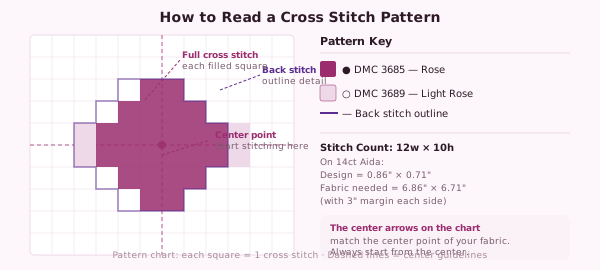
A cross stitch pattern is just a grid map. Each square in the grid represents one stitch. Each stitch is one color, and the key tells you which color goes where. That's the whole system. But when you're looking at a chart with 400 rows, 30 colors, and symbols you've never seen, it can feel overwhelming.
This guide breaks down every element of a cross stitch pattern and explains how to use it.
The Grid
Every cross stitch pattern is printed on a grid. Each square of the grid corresponds to one stitch on your fabric. If your pattern is 100 squares wide and 80 squares tall, your design will be 100 stitches wide and 80 stitches tall on the fabric.
That stitch count is important before you buy anything. Enter it in the cross stitch calculator and it tells you how big the design will be on your chosen fabric, and how much fabric to buy. A 100 × 80 stitch design on 14-count Aida comes out to 7.1" × 5.7". Add margins and you need at least a 13" × 12" piece of fabric.
The Color Key
The key (or legend) is a table beside or below the chart. It maps each symbol or color block to a thread color. Most modern patterns list DMC color numbers. Those are the numbers you use when shopping for floss.
Older printed patterns (from the 1980s–90s) sometimes used other brands. If your pattern lists "Anchor" or "Coats" numbers instead of DMC, you'll need a conversion chart. These are free online.
How to use the key:
1. Find a colored square or symbol on the chart
2. Match it to the key
3. The key gives you the DMC color number
4. Buy that skein number from any craft store or online retailer
Some keys also list the number of skeins recommended. Treat this as a rough guide. It's often a conservative estimate. Our floss estimator gives a more precise count based on your actual design area and coverage.
Symbols vs. Color Charts
Older patterns (and many specialty or heirloom designs) use printed symbols (a star, a dot, a dash, a triangle) to distinguish colors on black-and-white printed charts. Each symbol corresponds to a color in the key.
Modern charts sold as PDFs are usually color-filled: each square is printed in a color matching the thread color. These are much easier to read because you can identify color areas at a glance.
If you're working from a symbol chart:
- Print at a size where you can read the symbols clearly (sometimes you need to enlarge)
- Highlight completed sections with a yellow marker on a photocopy, never mark the original
- Work one color at a time to minimize symbol confusion
Full Stitches vs. Back Stitches vs. French Knots
Full cross stitch (×): A square filled with color. You make two diagonal stitches crossing over each other. The standard stitch.
Back stitch (–): A straight line that runs along a grid edge rather than diagonally across a square. Back stitches add outlines, detail, lettering, and facial features. They're almost always stitched after all the cross stitches are complete. Back stitches typically use 1 strand instead of 2.
French knots (•): Dots formed by wrapping thread around the needle and anchoring it on the fabric surface. Used for eyes, flower centers, and textured details. They're fiddly but not hard once you practice.
Quarter stitches and three-quarter stitches: Some complex designs include partial stitches for curved edges and fine detail. On Aida, you push the needle through the center of the square. On evenweave, you count threads precisely. These are more common in specialty and portrait designs.
Finding and Using the Center
Every cross stitch chart has a center point. Most patterns mark it with small arrows along the top/bottom edges and left/right edges pointing inward. Where the arrows meet is the chart center.
Why does this matter? Your finished design should be centered on your fabric. If you start stitching from a corner or a random point, you might run out of fabric on one side. Starting from the center and working outward ensures even margins.
To find the center of your fabric:
1. Fold the fabric in half, then in quarters
2. The fold intersection is the center
3. Mark it lightly with a water-soluble fabric marker or a single thread of a contrasting color through the center hole
To find the center of the chart:
1. Look for the arrows on the chart's borders (most patterns include these)
2. Or count the total squares: a 100 × 80 chart has its center at square 50 horizontally and square 40 vertically
Start your first stitch at or near the center, then work outward. You can work one color at a time across the chart, or one section at a time, whatever keeps you oriented.
How to Count Without Losing Your Place
Miscounting is the most common stitching error. You stitch a row of red, then realize the flower motif you just completed is one stitch off from where it should be, and now nothing lines up.
Strategies to stay on track:
- Use a magnetic board and ruler: Lay the printed chart on the board, hold your place with a magnetic strip across the current row. Move the strip as you complete each row.
- Tick off completed sections: Photocopy the chart and check off stitched areas with a pen.
- Count from landmarks: Instead of counting every stitch from scratch, count from the last clearly completed shape.
- Use a highlighter on the chart copy: Shade areas as you complete them. Very satisfying.
Multi-Page Charts
Large designs (samplers, full-coverage landscapes) are often printed on multiple pages that you tape together. Instructions usually include a diagram showing how the pages align.
Before you start stitching: print all pages, assemble them with tape, check that the overlap areas match (most charts have a few rows that repeat at the edges for alignment), and find the center of the assembled chart.
If you're adapting a multi-page chart to different fabric counts, the cross stitch size calculator handles the math. Enter the total stitch count (from all pages combined) and choose your fabric count.
Printed vs. Digital Patterns
Digital (PDF) patterns can be zoomed in on screen or printed at any size. The color symbols are visible at any zoom. You can annotate a printed copy freely. Most indie designers sell digital patterns because they're instant and convenient.
Printed booklets and kits come ready to use. The patterns are often smaller in physical size, which is harder to read. A magnifying glass or pattern magnifier can help.
One practical tip for digital patterns: print at 200% or 300% on multiple sheets. Large squares are much easier to count accurately than tiny ones.
Once you've read your pattern and found your stitch count, use the cross stitch calculator to plan your fabric and floss purchase. Our beginner's guide to cross stitch covers the full process from first supplies to finishing. And our guide to fabric counts explains how to choose the right fabric for any pattern.
Free Tool
Cross Stitch Calculator
Calculate fabric size, thread amounts, and project dimensions for your cross stitch patterns. Convert between fabric counts and estimate completion time.
Use the Calculator →Cross Stitch Calculator Team
We build free, accurate planning tools for counted cross stitch stitchers. Last updated .
Related Guides
Cross Stitch for Beginners: Start Your First Project
Everything you need to know to start cross stitching: supplies, fabric counts, reading a pattern, and making your first stitch.
craftsCross Stitch Fabric Counts: 11ct, 14ct, 18ct, 28ct Explained
Fabric count controls how big your finished design looks. Here's exactly what 11ct, 14ct, 18ct, and 28ct evenweave mean for your project.
crafts7 Common Cross Stitch Mistakes (And How to Fix Them)
From buying the wrong fabric size to hoop marks and skipped stitches, here are the mistakes most stitchers make and how to avoid them.