Fabric count is one of the first decisions you make in any cross stitch project, and it has more impact than most beginners expect. It controls the physical size of your finished design, how much thread you use, and how fine the detail can be.
What Does "Count" Mean?
Count refers to the number of stitches (or threads) per inch of fabric. A fabric labeled "14-count" has 14 stitch positions per inch in both directions. One stitch occupies 1/14 of an inch, about 1.8mm.
Higher count = smaller stitches = more detail possible.
Lower count = bigger stitches = faster to stitch, easier to see.
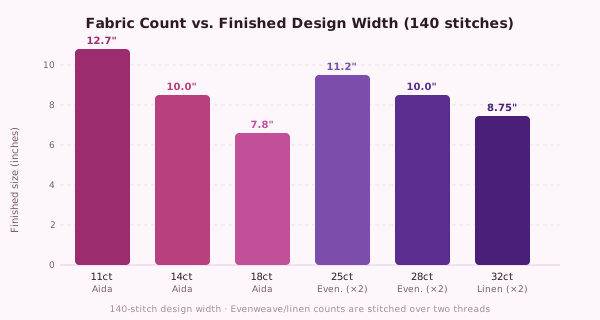
The chart above shows what a 140-stitch pattern looks like on different fabric counts. That same pattern produces a 12.7-inch design on 11ct Aida and a 7.8-inch design on 18ct Aida, a 63% size difference from the same pattern.
Use the cross stitch calculator to check how any pattern looks on any count before you buy fabric.
11-Count Aida
At 11 stitches per inch, 11-count Aida produces large, bold stitches. It's an excellent choice for:
- Beginners who are still learning the motion of cross stitch
- Designs that use thick lines and minimal detail
- Children's projects or items meant to be stitched quickly
- Beginner kits, which almost always use 11ct for accessibility
The downside: detailed photorealistic or portrait designs lose clarity on 11ct because each "pixel" (stitch) is too large. A 200-stitch-wide design becomes 18.2 inches. That's a very large piece of fabric.
Typical strand count: 3 strands of DMC mouliné.
Example size: 100 × 100 stitches = 9.1" × 9.1" design area.
14-Count Aida
14-count is the standard in cross stitch. If a pattern doesn't specify a fabric count, it almost certainly means 14ct. Most cross stitch patterns sold in shops, online, and in kits are designed with this count in mind.
It's small enough to produce clear, detailed images but large enough that you don't need magnification for most stitching sessions. The holes are easy to see and thread without much eye strain.
Typical strand count: 2 strands.
Example size: 140 × 120 stitches = 10.0" × 8.6" design area.
A common beginner project, a small floral motif at 80 × 80 stitches, comes out at 5.7" × 5.7" on 14ct. That fits comfortably in a 6-inch hoop. Run those numbers through the fabric size calculator to confirm before you cut your fabric.
16-Count Aida
Sixteen-count is a step up in fineness that some stitchers prefer once they're comfortable with 14ct. It's not as widely available in shops as 11ct or 14ct, but it's a good middle ground for stitchers who find 18ct too fine.
Typical strand count: 2 strands.
Example size: 140 × 120 stitches = 8.75" × 7.5" design area.
18-Count Aida
At 18 stitches per inch, each stitch is about 1.4mm. That's quite small, roughly the size of a typed period. The detail you can fit into an 18ct design is excellent, which makes it popular for:
- Portrait and landscape designs with fine shading
- Small decorative pieces with intricate lettering
- Any pattern that needs to fit into a small frame or locket
Working on 18ct for long sessions is harder on the eyes than 14ct. Many stitchers use a daylight lamp and a magnifying glass or clip-on magnifier. The effort is worth it for heirloom-quality detail.
Typical strand count: 1 strand (sometimes 2 for bolder areas).
Example size: 140 × 120 stitches = 7.8" × 6.7" design area.
28-Count Evenweave (Stitched Over Two)
This is where it gets slightly confusing if you're used to Aida. On evenweave fabric, you stitch over two threads in each direction. That means the effective count is half the fabric count: 28-count evenweave over two = 14-count effective.
The finished stitch size is exactly the same as 14-count Aida. The fabric just looks and feels different, finer weave, more drape, no visible block structure.
Why choose 28ct evenweave over 14ct Aida?
- The fabric looks more "finished" and less craft-store when framed
- Linen evenweave has a beautiful natural texture
- Many heirloom and specialty patterns are charted specifically for evenweave
Typical strand count: 2 strands (same as 14ct Aida).
Example size: Same as 14ct, 140 × 120 stitches = 10.0" × 8.6" design area.
The cross stitch thread calculator handles evenweave counts correctly, select "25 Count Evenweave (over 2)" or "28 Count Evenweave (over 2)" and it automatically applies the ÷2 adjustment.
32-Count Linen
Linen stitched over two gives an effective count of 16. The natural unevenness of linen threads adds charm but also means you'll encounter slightly irregular holes. Some stitchers love this; others find it frustrating.
Linen tends to be stiffer when new but softens beautifully with washing. It's the traditional choice for large samplers and heirloom pieces meant to last generations.
Typical strand count: 1–2 strands.
Example size: 140 × 120 stitches = 8.75" × 7.5" design area.
36-Count Linen
At 36ct stitched over two, you're working at an effective 18ct. This is advanced territory. Use a good magnifier, keep sessions short to prevent eye strain, and use 1 strand of floss. The results are stunning for miniature samplers and framed heirlooms.
Typical strand count: 1 strand.
Example size: 140 × 120 stitches = 7.8" × 6.7" design area.
How Fabric Count Affects Thread Use
Finer fabric means less thread per stitch. At 11ct, you use 3 thick strands that cover a larger hole. At 18ct, 1 or 2 thin strands cover a smaller one. Per stitch, less thread is consumed on finer fabric. But finer fabric also tends to produce more total stitches in the same physical area, so the total thread can still be similar.
Use the cross stitch fabric and floss calculator to model this exactly for your project. Enter your stitch count, select your fabric type, choose your strand count, and the calculator gives you a skein estimate based on DMC's standard 8.7-yard (313.2 inch) skeins.
Quick Reference: Fabric Count Cheat Sheet
| Count | Fabric Type | Stitch Size | Best For | Strands |
|---|---|---|---|---|
| 11ct | Aida | 0.09" | Beginners, bold designs | 3 |
| 14ct | Aida | 0.07" | Most patterns, standard | 2 |
| 16ct | Aida | 0.0625" | Intermediate step-up | 2 |
| 18ct | Aida | 0.056" | Fine detail, portraits | 1–2 |
| 25ct | Evenweave (×2) | 0.08" (eff) | Heirloom, over two | 2 |
| 28ct | Evenweave (×2) | 0.07" (eff) | Same size as 14ct | 2 |
| 32ct | Linen (×2) | 0.0625" (eff) | Samplers, advanced | 1–2 |
| 36ct | Linen (×2) | 0.056" (eff) | Miniatures, heirlooms | 1 |
For more on choosing between Aida and evenweave for the same pattern, see our Aida vs. evenweave comparison. And for a walk-through of a complete project, the beginner's guide to cross stitch covers fabric selection as part of a full planning process.
Want to see how your specific pattern looks on different counts? Try the cross stitch calculator, enter your stitch dimensions, and switch between fabric counts to compare finished sizes instantly. Learn more about how the calculator works on our About page.
Free Tool
Cross Stitch Calculator
Calculate fabric size, thread amounts, and project dimensions for your cross stitch patterns. Convert between fabric counts and estimate completion time.
Use the Calculator →Cross Stitch Calculator Team
We build free, accurate planning tools for counted cross stitch stitchers. Last updated .
Related Guides
Aida vs. Evenweave: Which Fabric Should You Choose?
Aida and evenweave look similar but stitch differently. Here's how to pick the right fabric for your cross stitch project.
craftsCross Stitch for Beginners: Start Your First Project
Everything you need to know to start cross stitching: supplies, fabric counts, reading a pattern, and making your first stitch.
craftsDMC Floss: How Many Skeins Do You Need?
Running out of floss mid-project is frustrating. This guide shows how to estimate DMC skein counts for any project size.