Aida and evenweave both work for counted cross stitch, but they're different in feel, structure, and how you stitch on them. The wrong choice won't ruin a project, but the right one makes the work more pleasant and the finished piece look better.
What Is Aida Cloth?
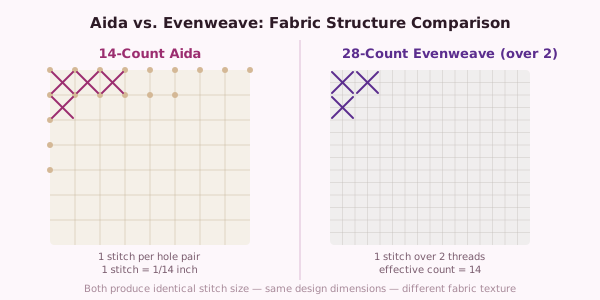
Aida is a woven cotton fabric with a built-in grid. The threads are grouped in blocks, and the holes between them line up perfectly in rows and columns. Each hole is a corner of one stitch square. You push the needle through the hole, over to the diagonal corner, and back. That's your cross stitch.
The grid structure makes Aida very easy to stitch on. You can count squares at a glance, and the holes are large enough to see clearly, even without magnification. That's why 14-count Aida is the first recommendation for new stitchers. It's forgiving, widely available in every craft store, and most beginner patterns are designed for it.
Common Aida counts:
- 11-count: Large stitches, about 0.09 inches each. Ideal for bold designs and young stitchers.
- 14-count: The standard. One stitch = 0.07 inches. Works for nearly everything.
- 16-count: A middle ground, finer than 14ct but more manageable than 18ct.
- 18-count: Fine detail, good for portraits and complex patterns. Magnification helps.
- 22-count Hardanger: Even finer, mainly used for Hardanger embroidery, not general cross stitch.
Before you buy, use our cross stitch calculator to enter your pattern's stitch count and the Aida count you're considering. The calculator shows you exactly how big the design comes out, no guessing.
What Is Evenweave?
Evenweave is a fabric where the warp and weft threads are the same thickness, giving a consistent weave in both directions. Unlike Aida, there are no grouped blocks; the threads are individual. You stitch *over two threads* in each direction, which means each stitch spans two horizontal and two vertical threads.
The most common evenweave counts are 25ct, 28ct, and 32ct. Here's the key fact: when you stitch over two threads, the effective count is half the fabric count. A 28-count evenweave stitched over two gives you the same physical stitch size as 14-count Aida. Same design size, different fabric texture.
Common evenweave fabrics:
- 25-count evenweave: Over two = 12.5ct effective. Slightly larger stitches than 14ct Aida.
- 28-count evenweave: Over two = 14ct effective. Direct substitute for 14ct Aida in terms of finished size.
- 32-count evenweave/linen: Over two = 16ct effective. Fine work.
- 36-count linen: Over two = 18ct effective. Heirloom quality, requires care and often magnification.
Linen is a specific type of evenweave made from flax. It has a slight irregularity in the weave that some stitchers love for its natural look, while others find the uneven holes frustrating. Pure linen softens with washing and handles beautifully for framed pieces or heirlooms.
How to Stitch on Evenweave (Over Two)
On Aida, each stitch goes from hole to hole. On evenweave, you count threads instead. Your needle goes under a thread, over two threads, and back. The cross is worked over a 2×2 thread square.
This requires more counting, especially when you first switch from Aida. A common mistake is starting the first stitch over one thread by accident, so check your work every few stitches until the rhythm feels natural.
One practical advantage: evenweave has no "right" side vs. "wrong" side in the same way Aida does. Both sides of the fabric look similar, which gives more flexibility if you're mounting or finishing the piece.
Design Size: How to Calculate It
Here's where the cross stitch fabric calculator becomes useful. Say you have a pattern that's 140 stitches wide × 120 stitches tall.
On 14ct Aida:
- Design width = 140 ÷ 14 = **10.0 inches**
- Fabric needed (with 3-inch margin each side) = 10.0 + 6 = **16.0 inches**
On 28ct evenweave (over two):
- Effective count = 28 ÷ 2 = 14
- Design width = 140 ÷ 14 = **10.0 inches** (same)
- Fabric needed = same 16.0 inches
On 14ct Aida vs. 11ct Aida:
- On 11ct: 140 ÷ 11 = 12.7 inches, a 27% larger design
- Fabric needed = 12.7 + 6 = **18.7 inches**
Try different counts in the calculator to see how the finished size changes before you commit to buying fabric.
Thread Use: Does Fabric Type Affect Skein Count?
Yes, a little. On Aida, you typically use 2 strands of DMC mouliné for 14ct, 3 strands for 11ct, and 1 strand for 18ct. On evenweave and linen, the recommendations are similar per effective count: 2 strands over two on 28ct evenweave is the same as 14ct Aida.
The physical thread usage per stitch is nearly identical when the effective count matches. Where evenweave sometimes uses slightly less thread is when stitchers work with 1 strand for very fine detailing on high-count linen. Our DMC floss guide breaks this down by project size.
Which Should You Choose?
Go with Aida if:
- You're new to cross stitch
- The pattern is designed for Aida
- You want easy counting and clear holes
- You're buying from a general craft store
Go with evenweave or linen if:
- You want a softer drape and a finer finished look
- You're making a heirloom piece or using linen for framing under glass
- You've already mastered 14ct Aida and want a new challenge
- The pattern specifically calls for evenweave (some specialty designs are charted for it)
Both are completely valid choices for the same patterns. The effective stitch size can be matched exactly. If you want the look of linen but the ease of Aida, many brands sell "Aida with a linen look", a cotton Aida with a linen-like texture.
Not sure how the fabric switch affects your supply list? Run your numbers through the calculator and compare. It only takes a minute.
Care and Washing
Aida is almost always 100% cotton and machine washable at 30–40°C. It's practical and durable.
Linen should be hand-washed or washed on a delicate cycle. It may shrink 3–5% on the first wash. Some stitchers pre-wash their linen before stitching to eliminate that shrinkage from the finished piece. Evenweave cotton is more stable than linen but still benefits from gentle washing.
Both types should be ironed while slightly damp, on the reverse side (never iron directly on stitching), and allowed to dry flat to prevent distortion.
For more guidance on planning your project, visit our About page to learn how this calculator's formulas were developed, or check out the complete guide to fabric counts for a deeper look at all count options.
Free Tool
Cross Stitch Calculator
Calculate fabric size, thread amounts, and project dimensions for your cross stitch patterns. Convert between fabric counts and estimate completion time.
Use the Calculator →Cross Stitch Calculator Team
We build free, accurate planning tools for counted cross stitch stitchers. Last updated .
Related Guides
Cross Stitch Fabric Counts: 11ct, 14ct, 18ct, 28ct Explained
Fabric count controls how big your finished design looks. Here's exactly what 11ct, 14ct, 18ct, and 28ct evenweave mean for your project.
craftsDMC Floss: How Many Skeins Do You Need?
Running out of floss mid-project is frustrating. This guide shows how to estimate DMC skein counts for any project size.
craftsCross Stitch for Beginners: Start Your First Project
Everything you need to know to start cross stitching: supplies, fabric counts, reading a pattern, and making your first stitch.