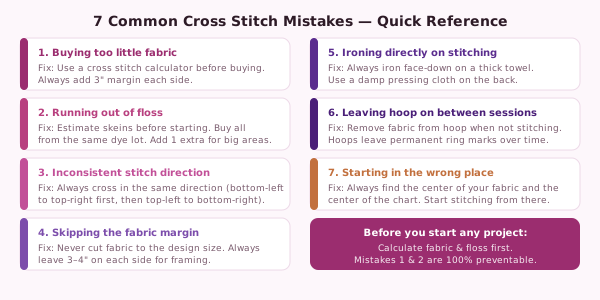
Most cross stitch mistakes fall into two categories: planning mistakes that happen before you pick up a needle, and stitching mistakes that happen during the project. The good news is that most of them are avoidable, and most of the stitching ones can be fixed without restarting.
Mistake 1: Buying Too Little Fabric
This is the most common beginner error. Someone finds a pattern, sees it's 140 × 120 stitches on 14-count, divides by 14 to get 10" × 8.6", and cuts a 10" × 9" piece of fabric. Then they discover they need a margin to hold in a hoop or frame, and suddenly there's no room to work.
How to fix it: Always add at least 3 inches on each side of your design. A 10" × 8.6" design needs fabric that's at least 16" × 14.6". Use the cross stitch calculator before you buy. Enter your stitch count, choose your fabric count, and the fabric size output already includes the margin.
If you're already mid-project with too-small fabric, you can sometimes join a strip of fabric to the sides with a whip stitch or by stitching on evenweave fabric that can be butted together. But it's a pain. Better to plan ahead.
Mistake 2: Running Out of Floss
You're halfway through a large sky background. You run out of that particular shade of blue. You order more. It arrives, you compare, and the new skein is a slightly different dye lot. The difference is subtle, but visible under light. Now you have a sky with a faint band across it where you switched skeins.
How to fix it: Estimate your floss before you start. The cross stitch floss estimator gives you a total skein count based on your design's stitch count, coverage, and strand count. Buy all your skeins at once, from the same shop if possible. For any color covering more than 20% of your design, add one extra skein as insurance.
If you've already run out and need to blend dye lots: switch to the new skein partway through a row, not at the start of a new row. The blend is less visible when it happens gradually.
Mistake 3: Inconsistent Stitch Direction
Every cross stitch is two diagonal stitches forming an X. The stitches look best when all the top diagonals run in the same direction across the entire piece. If some top diagonals run bottom-left to top-right and others run top-left to bottom-right, the piece looks messy and textured unevenly, especially in solid color areas.
How to fix it: Pick a direction before you start your first stitch and stick to it. Most stitchers work the bottom diagonal from bottom-left to top-right, then the top diagonal from top-left to bottom-right. Write it on a sticky note and attach it to your work board.
If you've already stitched a section inconsistently and it bothers you: remove the stitches with a seam ripper or blunt needle, and re-stitch. For small mismatched areas in the middle of a design, it often becomes invisible once surrounding stitches are complete.
Mistake 4: Not Centering Your Design on the Fabric
Starting from a corner or a random point on the chart means you might run out of fabric on one side before the design is finished. Or the design ends up off-center in your frame.
How to fix it: Find the center of your fabric by folding it in quarters and marking the center point lightly with a water-soluble marker. Find the center of your chart (most patterns mark it with arrows). Start stitching from the center and work outward.
If you've already started from the wrong spot: count stitches from your current position back to the center, then count how far you are from the fabric center. If the design will still fit with margins, continue. If not, the earlier you catch this the less you'll have to unpick.
Mistake 5: Leaving the Hoop on Between Sessions
A plastic or wooden hoop left clamped on fabric for weeks will leave a permanent ring mark (a rounded crease where the inner ring compressed the fabric). On pale fabric you get an oval shadow. On dark fabric it shows as a lighter ring. Either way, it's hard to remove after the fact.
How to fix it: Remove your fabric from the hoop at the end of every stitching session. Yes, every time. It takes 10 seconds. Some stitchers partially loosen the screw rather than removing the fabric entirely. That reduces the pressure but doesn't fully eliminate the risk.
If you've already got a hoop mark: wash the piece (which often relaxes the crease) and block it flat while damp. Many hoop marks disappear with washing and blocking. If it doesn't, professional pressing by a framer can sometimes remove the remainder.
Mistake 6: Ironing Directly on Stitching
Cross stitch stitches are three-dimensional. They sit slightly above the fabric surface. A hot iron pressed directly on the stitches flattens and deforms them. The stitches look crushed and lose their textured appearance. This is very hard to reverse.
How to fix it: Never iron face-up. If you need to press the finished piece: lay it face-down on a thick, clean white towel. Place a damp pressing cloth on the back. Press gently with a warm iron. The towel lets the stitches sink into it without deformation.
For blocking (before framing), washing and pinning to dry is always preferable to ironing.
Mistake 7: Stitching Over Loose Thread Ends
When you start a new thread or finish one, the loose end needs to be secured. A common shortcut is to run the end under a few existing stitches on the back. That's fine. What's not fine is leaving the end loose or tying a knot. Knots create bumps visible on the front of the piece. Loose ends work themselves loose and unravel.
How to fix it: Use the loop method for starting. With even-numbered strands, fold the strand in half, thread the loop end through the needle, make your first stitch, and pass through the loop before pulling tight. No knot needed. For finishing: run the needle through the backs of 4–6 existing stitches in a zigzag pattern, then trim the end.
If you've already knotted threads throughout your piece: it may not be noticeable after framing if the piece is mounted flat. If knots are visible from the front as bumps, you'll need to unpick and re-stitch those areas.
The first two mistakes on this list, fabric size and floss quantity, are completely preventable with a few minutes of calculation before you buy supplies. The cross stitch calculator handles both. Enter your pattern dimensions and it gives you your fabric size (with margin) and an estimated skein count.
For help choosing the right hoop or frame to avoid mistake #5, see our guide to hoops vs. frames. And for finishing and framing your completed project, our step-by-step finishing guide covers washing, blocking, and mounting.
Free Tool
Cross Stitch Calculator
Calculate fabric size, thread amounts, and project dimensions for your cross stitch patterns. Convert between fabric counts and estimate completion time.
Use the Calculator →Cross Stitch Calculator Team
We build free, accurate planning tools for counted cross stitch stitchers. Last updated .
Related Guides
Cross Stitch for Beginners: Start Your First Project
Everything you need to know to start cross stitching: supplies, fabric counts, reading a pattern, and making your first stitch.
craftsHow to Finish and Frame Your Cross Stitch: Step-by-Step
Washing, blocking, mounting, and framing your finished cross stitch. A practical guide to presenting your work properly.
craftsCross Stitch Hoop vs. Frame: Which Is Better?
Hoops are cheap and portable. Frames keep fabric taut without marks. Here's how to choose the right one for your project.